
Resources› Articles
Article
3 min read
Not Just Another “Connector”: Why CI’s Matter Connector Actually Solves Firm’s Data Issues
4 unique CI Matter Connector features that actually solve law firms' data issues and distinguish it from other "connector" products.

Kwasi Bowman
May 27, 2025
Many docket providers offer tools that connect their data to clients’ internal systems. These are “point-to-point connectors” that move data from one database to another. While these tools address some use cases, they do not resolve the issues that surface when a firm subscribes to multiple docket providers. These issues include dirty, unstructured, and siloed data ecosystems.
At CI, we take a fundamentally different approach to other “connectors.” The CI Matter Connector (“CI MC”) isn’t built to move just one vendor’s data to a single client system—it’s a holistic and agnostic solution designed to clean, structure, enrich, and connect your internal matter data to multiple external sources. The aggregated information is supplied via a single, usable framework that is accessible across an organization’s systems.
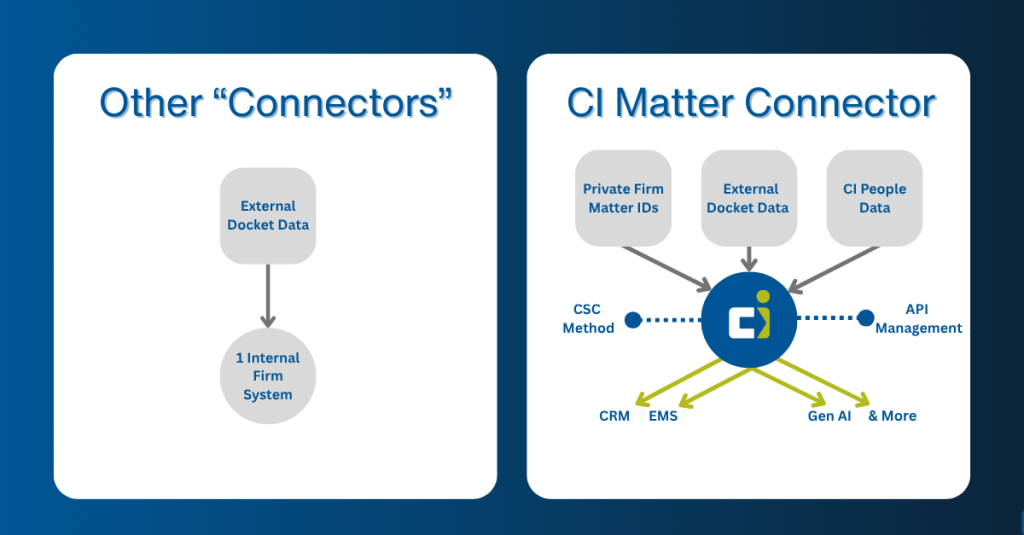
4 Unique CI Matter Connector Features that Actually Address Firms’ Data Issues:
- Enriched People Data
We go beyond basic matter information. Our connector layers enriched legal professional information on top of matter data; therefore, unlocking deeper insights from your existing data.
- Master Identifiers (CI IDs)
You need more than good data—you need consistent data. Our proprietary CI IDs unify entity records across platforms, eliminating duplicates and conflicting entries while preserving accuracy, freshness, and continuity.
- Trusted Integrations
We’ve built automated, trusted integrations with the data providers that law firms rely on most, such as LexisNexis, vLex Docket Alarm, and Lex Machina. That means a minimal lift for your IT team and quicker deployment within your existing environment.
- Exportable SQL Tables
Unlike closed ecosystems that trap imported data, the CI Matter Connector offers fully exportable tables that reside within a firm’s data environment. This enables enriched, structured data to flow directly into Experience Management Systems, internal dashboards, CRMs, and more.
Is Your Matter Data Actually Working For You?
If your current solution only connects one provider’s data to a single internal system, you’re still left with fragmented insight and missing context.
With CI, you gain a scalable, adaptable solution that puts clean, enriched, and connected people and matter intelligence at the heart of your firm’s decision-making.
Many clients are already leveraging the increased data visibility from CI’s MC to deploy advanced use cases, such as internal document repositories, indexed case histories from lateral hires, and more. CI not only makes these things technically possible, but also minimizes the internal resource needs to deploy new tools.
Let’s move beyond limited connections and see what lies hidden within the connections of legal data.
Contact us at sales@courtroominsight.com to learn how the CI Matter Connector supports smarter workflows, stronger insights, and a unified data strategy.
See how Courtroom Insight can work in your firm's stack.
Request a Demo →